Recognize a Team Member or Volunteer and Reinforce What Matters

1. Start Here
Team members and volunteers do useful things every day. They notice a need, solve a problem, make someone feel welcome, or step in before being asked. Most of those moments disappear because nobody stops to capture what happened.- One real moment.
- The person’s name and role.
- What they noticed and did.
- Why it mattered to someone.
- One quote or photo, when available and appropriate.
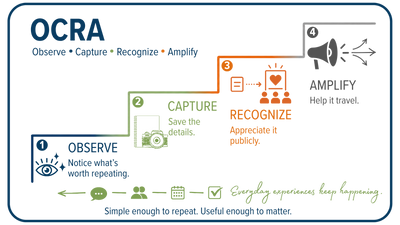
2. Observe & Capture
Observe
Look for a team member or volunteer who:
- Made a difficult or uncertain moment easier.
- Noticed and addressed a need before being asked.
- Explained something in a way that helped someone move forward.
- Demonstrated the service, judgment, care, or community commitment you want repeated.
Capture
Preserve the details before they disappear:
- What was happening before the person stepped in?
- What did they notice?
- What specific action did they take?
- What changed for the customer, participant, coworker, or community?
- What exact words did someone use to describe the difference?
- Do you have permission to use the person’s name, photo, and quote?
Avoid settling for broad descriptions such as “always helpful” or “a great team player.” Capture one real example that allows people to see the behavior for themselves.

- What did you notice that needed attention?
- What did you decide to do?
- Why did that response matter in the moment?
- What changed as a result?
- What would you want someone else to know about the experience?
3. See an Example
Here is how one everyday contribution moves from Capture to meaningful recognition.
What you capture:
The situation: A first-time visitor arrived for a Saturday community workshop and was unsure where to check in or what to expect.
What Jordan noticed: The visitor was standing near the entrance and looking between the registration table and the activity room.
What Jordan did: Jordan paused setup, welcomed the visitor, explained how the workshop worked, and introduced them to the activity leader.
The visitor’s words: “Jordan made me feel like I belonged before I even knew where to go.”
What you recognize and publish:
Suggested title: How Jordan Helped a First-Time Visitor Feel Welcome
The story: When a first-time visitor arrived for Saturday’s workshop, Jordan noticed they were unsure where to begin. Jordan stopped what they were doing, offered a warm welcome, explained the next step, and made a personal introduction. That small act helped the visitor feel comfortable enough to participate.
Why it matters: A clear welcome can turn uncertainty into participation. Jordan’s example shows the kind of awareness and care we want every visitor to experience.
The visitor’s next step: New to one of our programs? Let us know when you arrive. We will help you get oriented and comfortable.
The same pattern works in many settings:
- Retail: Recognize an associate who helped a shopper compare options without pressure.
- Professional services: Recognize a team member who made a complicated process easier to understand.
- Nonprofit or community work: Recognize a volunteer who helped a new participant feel included.
4. Recognize & Amplify
Recognize
- Describe the situation.
- Show what the team member or volunteer noticed and did.
- Explain what changed.
- Include one real quote or detail.
- Connect the example to a value or behavior worth repeating.
- How [Name] Helped [Person or Group] [Positive Outcome]
- Thank You, [Name], for [Specific Contribution]
- A Small Act That Made [Experience or Outcome] Easier
Amplify
- Share the website link in your next email newsletter.
- Adapt the introduction for social media and link back to the full story.
- Tag the recognized person or a relevant partner only with permission.
- Share it with the customer, participant, or coworker whose experience made the story possible.
- Extend its reach through Local Connections when the story is useful to the broader community.
5. Get Going

Choose one helpful action you observed during the past seven days.
Write down what the person noticed, what they did, and what changed. Ask the person they helped, or someone who witnessed it, for one sentence about why the action mattered.
Use the Behavior Worth Repeating Worksheet to capture the details and shape one short website story. Publish it, share it in one relevant place, and then look for the next useful behavior to recognize.
Download the Behavior Worth Repeating Worksheet →

👉 Request a Demo and we’ll show you how to publish once and help useful stories travel.