
How to Use OCRA to Capture Everyday Value
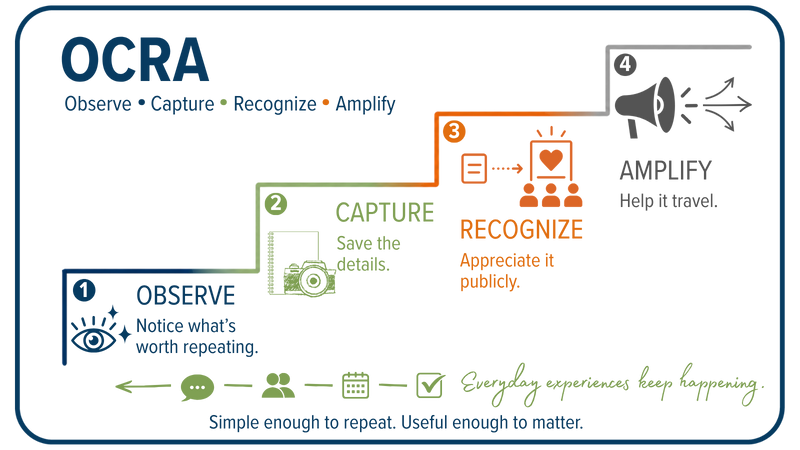
1. Start Here
You only need ...
→ A project, partner, question, person, improvement, or behavior worth
✅ A few real details.
✅ One reason it matters.
→ Identify what became easier, clearer, more useful, or more successful.
✅ One place to help it travel.
→ Give the useful result a reliable home, then help it travel.
2. Observe
Look for moments connected to a result you actually care about:- Someone asks a question that reveals uncertainty.
- A customer, member, donor, visitor, or participant says, “I didn’t know you did that.”
- An employee or volunteer makes something easier, clearer, safer, or more welcoming.
- A project, appointment, event, visit, or purchase turns out better because of one useful detail.
- A partner contributes time, knowledge, reach, or trust.
- Someone demonstrates a behavior you want others to repeat.
Do not ask, “What should we post today?” Ask, "What happened today that could help someone understand, trust, participate, or take the next step?"
3. Capture
Capture is not publishing. It preserves the raw material before the moment disappears:
Their words: What did they ask, notice, need, or say?
Your prompt: What useful follow-up question did you ask?
Their response: What did they explain or realize in their own words?
Supporting context: What facts, photos, timing, or permission help explain the moment?
A few notes, a voice memo, or one follow-up question may be enough.
See an Everyday Example
Someone finishes an interaction and says:
“That made this much easier than I expected.”
They arrived uncertain. Someone asked a helpful question, explained the next step, and made the experience easier.
Capture:
What they were trying to accomplish
What created uncertainty
What your team asked or explained
The detail that helped
What the person said afterward
The moment could be a product recommendation, dietary accommodation, project-preparation tip, volunteer welcome, or helpful partner introduction.
The industry changes. The habit does not.
4. Recognize what matters
Recognition is public appreciation with purpose. Decide what the moment demonstrates:
Experience or expertise
Care and service
Values or community impact
A useful result
A behavior worth repeating
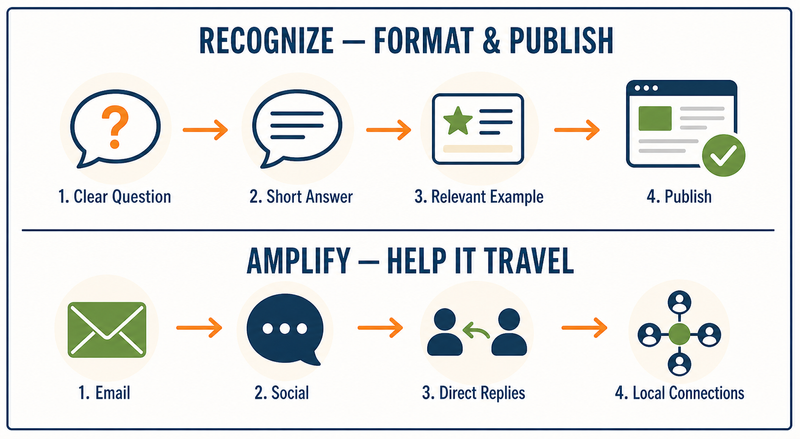
Give what you captured one useful form: a story, answer, project example, checklist, spotlight, recap, or partner recognition.
Use four simple parts:
What was someone trying to accomplish?
What helped them move forward?
What detail or quote makes the example real?
What should someone in a similar situation do next?
Keep the customer, participant, partner, or community member as the hero. Your organization is the guide.
5. Amplify what you recognized
Publish the complete version on your website, then help it travel:
Share one useful detail through email.
Reuse a quote, photo, or takeaway on social media.
Include the link in direct replies and referrals.
Notify relevant partners or use Local Connections™.
Complete one useful OCRA cycle first. Improve, delegate, automate, and connect it later.
6. Get Going

Choose one thing from this week:
One project
One partner
One person who helped
One customer or participant experience
One improvement
One behavior you want repeated
Spend 15 minutes preserving what happened and why it mattered.
Capture the person’s words, your prompt, their response, and the necessary context. Decide what deserves to be recognized, give it one useful published form, and share it in one relevant place.
Then do it again.
That is how OCRA becomes a sustainable habit instead of another marketing idea you agree with but never use.
One useful example creates clarity. Repeated examples build trust, authority, referrals, participation, and a clearer understanding of the value you already create.
Download the One Useful Thing OCRA Worksheet

👉 Request a Demo and we’ll show you how easy it is to turn support into impact.